Running marketing for a small business often means doing everything yourself: writing emails, creating social posts, designing ads, researching keywords, optimizing content, and tracking campaigns. That’s where AI marketing tools for small business make a real difference.
The right AI marketing software doesn’t replace your whole stack it automates repetitive work, speeds up content production, improves targeting, and helps a small team compete with much larger companies. But not every AI tool is a marketing tool. A general AI chatbot can help you write an email; dedicated marketing software connects that content to email campaigns, social publishing, SEO, advertising, analytics, or customer data. (If you want AI tools beyond marketing, see our broader best AI tools for small business guide.)
In this guide, we compare 10 of the best AI marketing tools for small business in 2026 across email, content, social media, SEO, design, advertising, and automation.
What are AI marketing tools?
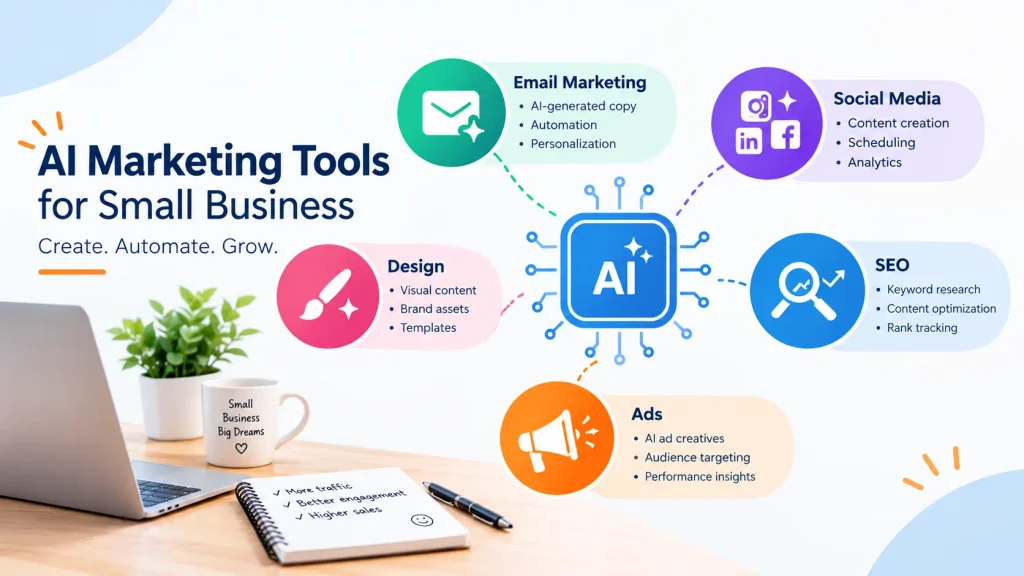
AI marketing tools are software platforms that use artificial intelligence to help businesses plan, create, optimize, automate, or measure marketing. Depending on the platform, AI can help with email copy, social content, blog and SEO content, keyword research, ad creatives, audience targeting, automation, and campaign analysis.
The key difference is marketing workflow integration. Canva uses AI to create visual content and ads; Buffer combines AI with social scheduling; Semrush focuses on SEO and search visibility; Brevo ties AI to email marketing, automation, and customer communication. That connection to a real marketing channel is what separates a marketing tool from a generic AI assistant.
How AI marketing tools help small businesses
Small businesses usually have limited marketing resources. AI helps them do more without hiring another full-time employee:
- Faster content creation: first drafts for emails, social posts, landing pages, and blog content.
- More consistent marketing: brand voice, templates, and reusable workflows keep campaigns consistent across channels.
- Better SEO decisions: AI-powered platforms analyze keywords, competitors, and content gaps.
- Easier social media: generate ideas, write captions, and schedule posts instead of doing it all by hand.
- More efficient advertising: produce multiple creative variations and spot which are likely to perform.
The 10 best AI marketing tools for small business
1. Brevo – best for email marketing
Best for: email marketing and automation.
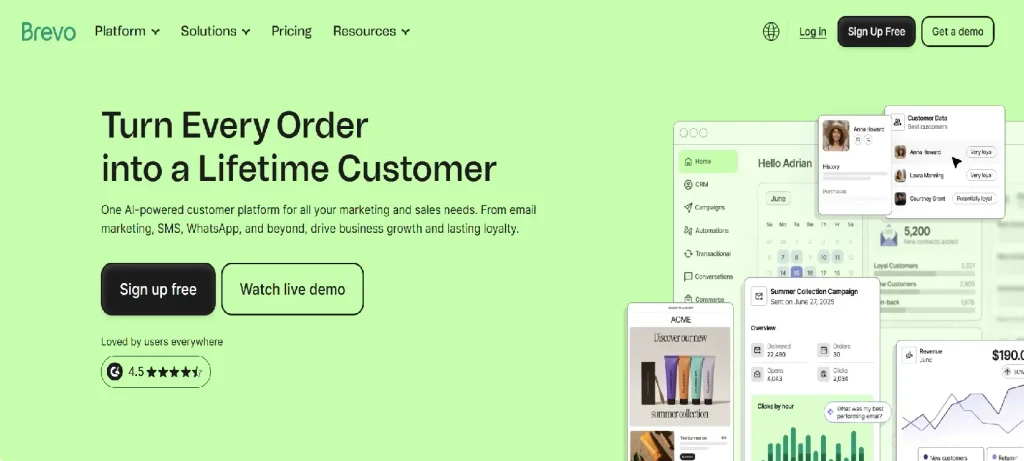
Brevo is one of the strongest picks for small businesses that want email marketing combined with automation and customer communication. Its AI helps create email content, optimize campaigns, and automate customer journeys plus email, SMS, WhatsApp, chat, and CRM features, so it’s more than a newsletter tool.
Key features: AI content generation, email campaigns, marketing automation, SMS/WhatsApp, segmentation, analytics.
Pricing: Free plan available. Paid plans start at $9/month (Starter) and $18/month (Standard).
Our verdict: a strong, affordable option for email-first marketing without a complicated stack. Pair it with our email marketing funnel guide to set up your first automated sequence.
2. Jasper- best for marketing content
Best for: marketing copy and brand-focused content.
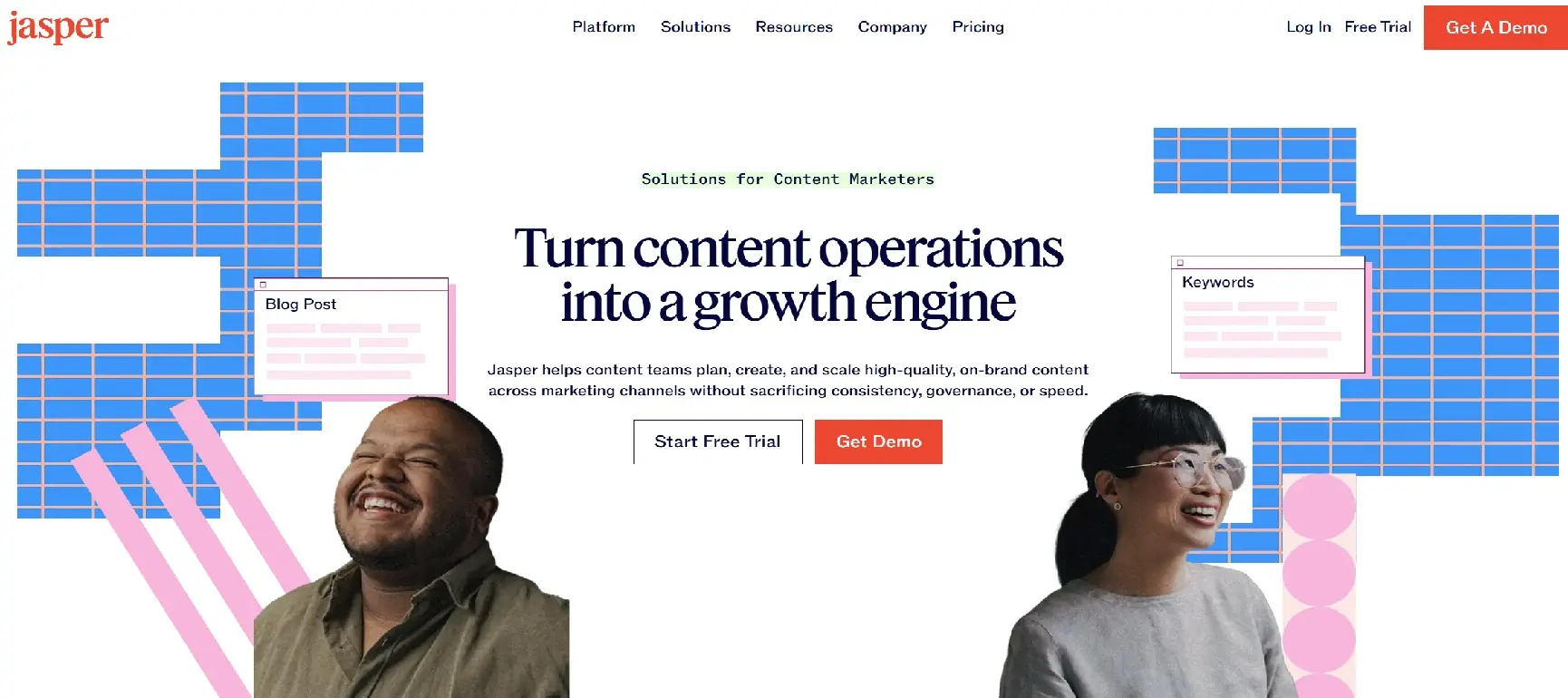
Jasper is built around marketing rather than general AI chat. It creates content across campaigns while keeping a consistent brand voice, with tools for written and visual on-brand content.
Key features: AI marketing copy, brand voice, campaign and blog content, social copy, multiple brands, marketing workflows.
Pricing: Jasper Pro is $69/month billed monthly, or $59/month billed annually. Business pricing is custom.
Our verdict: best for businesses producing a lot of marketing content that needs stronger brand consistency than a basic AI writer.
3. Copy.ai – best for marketing workflows
Best for: marketing automation and go-to-market workflows.
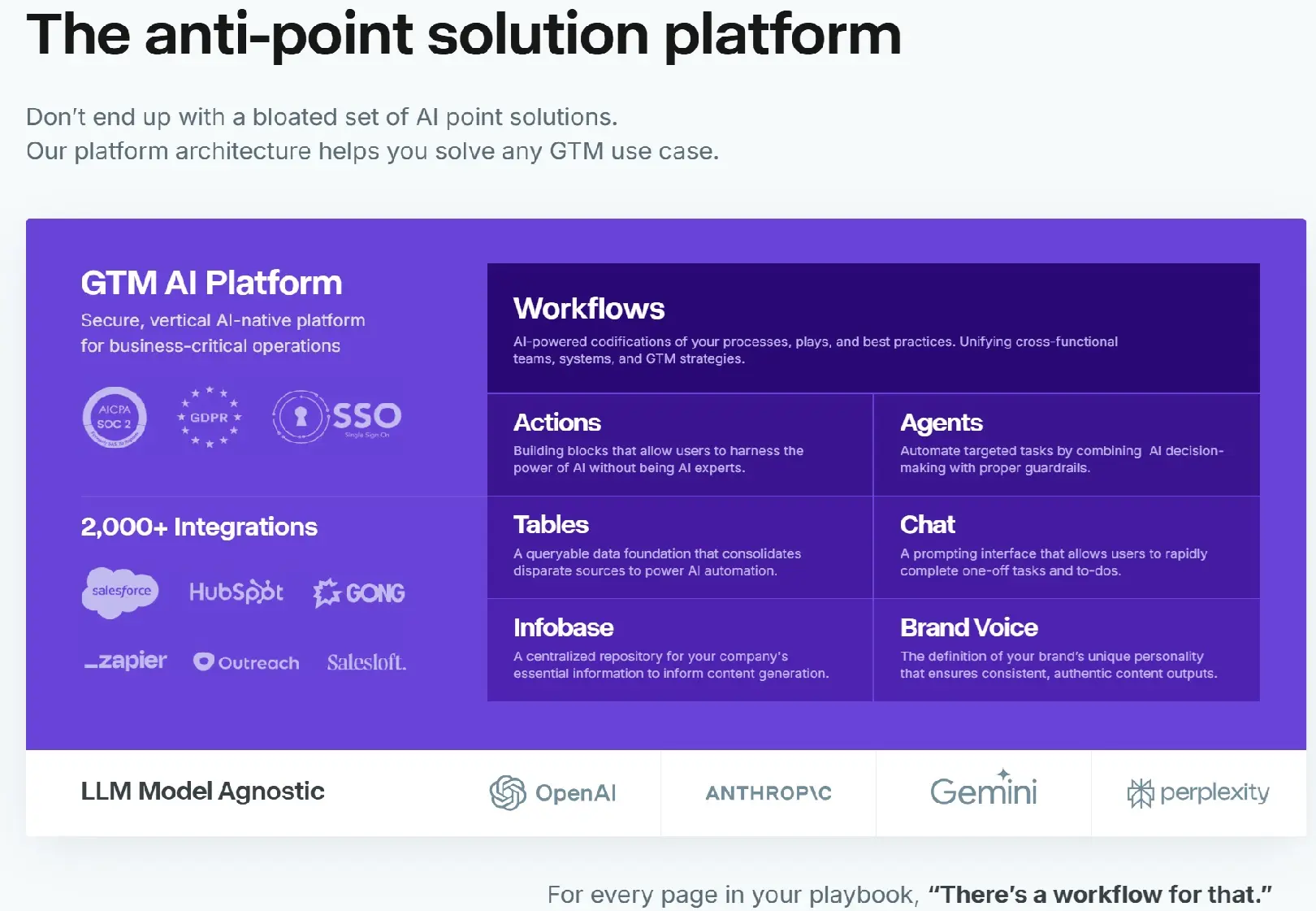
Copy.ai has moved beyond simple copywriting. In 2026 it leans into “GTM AI,” connecting marketing, sales, data, and workflows to automate repetitive processes like content creation, research, and data enrichment.
Key features: AI content, workflow automation, brand voice, lead research, data enrichment, marketing/sales workflows.
Pricing: the self-serve Chat plan starts at $29/month, or $24/month billed annually. Larger team/enterprise plans step up sharply.
Our verdict: interesting for businesses that want AI to automate marketing processes, not just generate text. See our how to use AI automation for small business guide for building those workflows.
4. Canva – best for marketing design
Best for: social graphics, ads, and visual marketing.
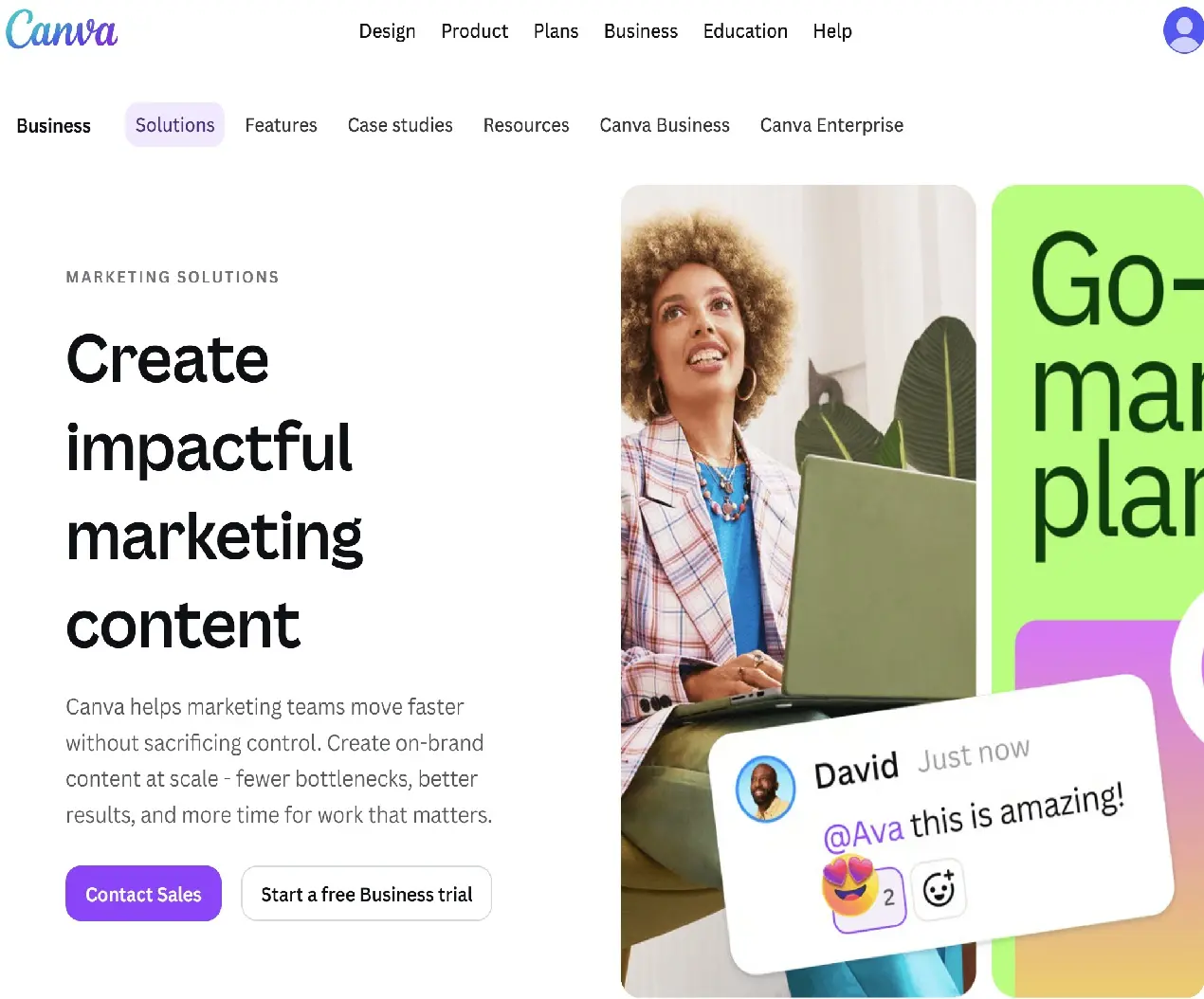
Canva is one of the easiest ways for a small business to create professional marketing materials without a designer. Its AI now covers design generation, writing, resizing, translation, image editing, video, and advertising including AI ad creation and ad insights.
Key features: AI design and image generation, AI writing, social content, ad creation, Brand Kits, social scheduling, ad insights.
Pricing: Canva Free is $0. Canva Pro is $144/year for one person; Canva Business starts at $250/year per person.
Our verdict: for social graphics, ad creatives, presentations, and branded content, Canva is one of the most practical AI marketing tools available.
5. Buffer – best for social media marketing
Best for: social media scheduling.
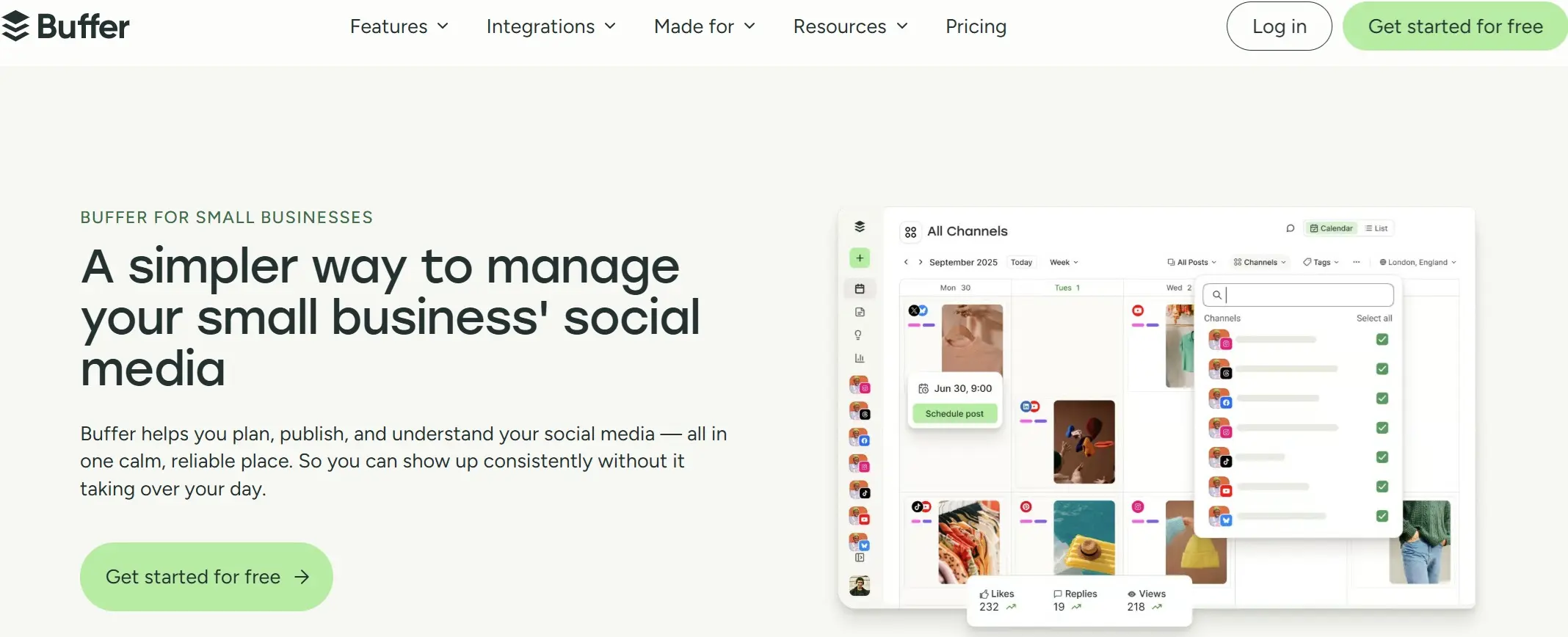
Buffer pairs social publishing with an AI assistant, analytics, content ideas, and engagement tools. The free plan supports up to three channels and includes the AI Assistant.
Key features: AI Assistant, scheduling, content ideas, analytics, community inbox, multi-platform publishing.
Pricing: Free plan available. Essentials starts at $5/month per channel (annual); Team at $10/month per channel (annual).
Our verdict: a good fit for small businesses that know their channels and want a simple, consistent publishing schedule.
6. Predis.ai – best for AI social content and ads
Best for: AI-generated social content and advertising.
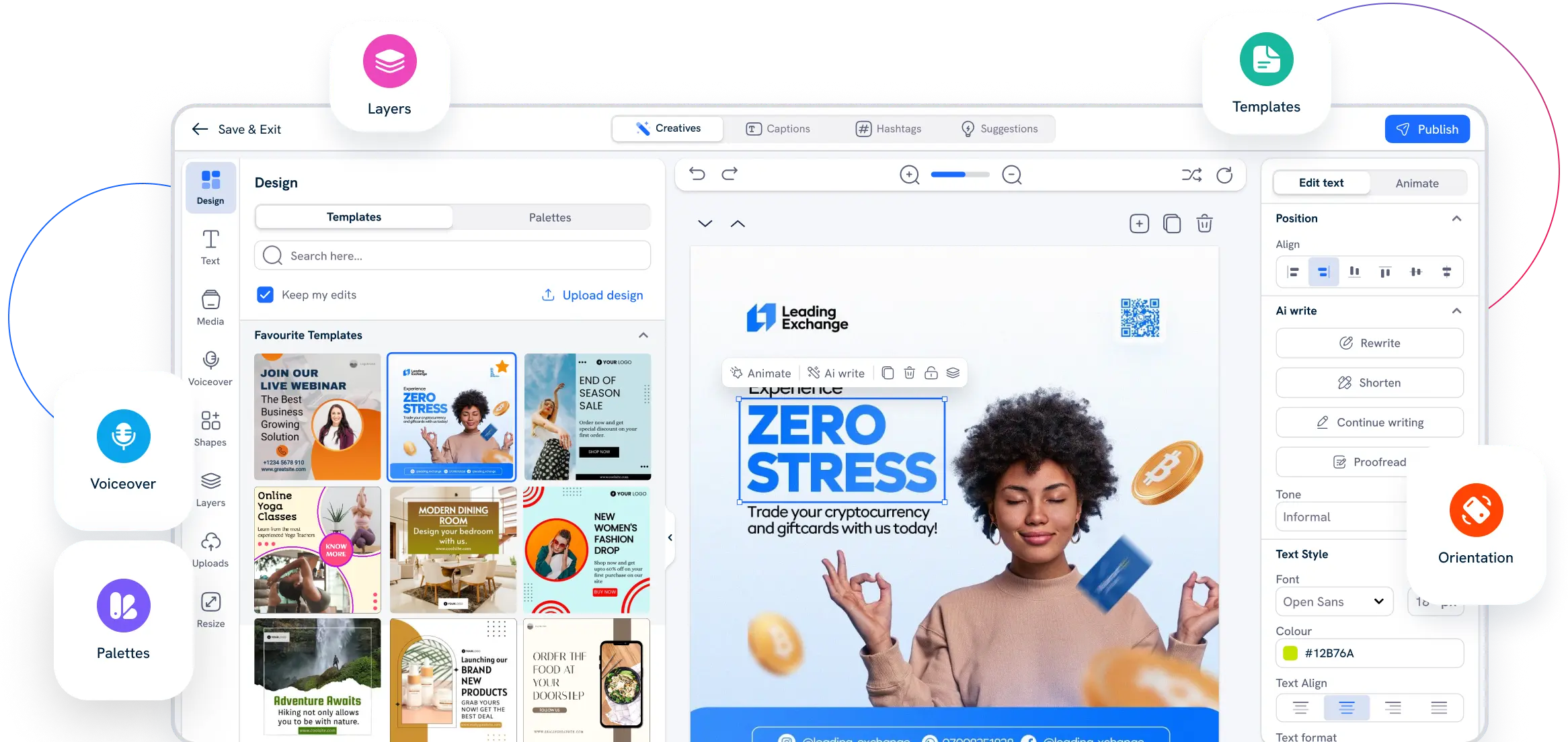
Predis.ai focuses on generating marketing assets rather than just scheduling. It creates social posts, images, videos, ads, and UGC-style content, plus competitor analysis and publishing.
Key features: AI social posts, AI videos, ad creation, UGC content, competitor analysis, multi-brand management.
Pricing: Core starts at $24/month (annual); Rise at $55/month; Enterprise+ at $212/month. Each plan includes a 7-day trial.
Our verdict: useful for businesses that need a steady stream of social and ad creatives without designing each one by hand.
7. Semrush – best for SEO
Best for: SEO and search visibility.
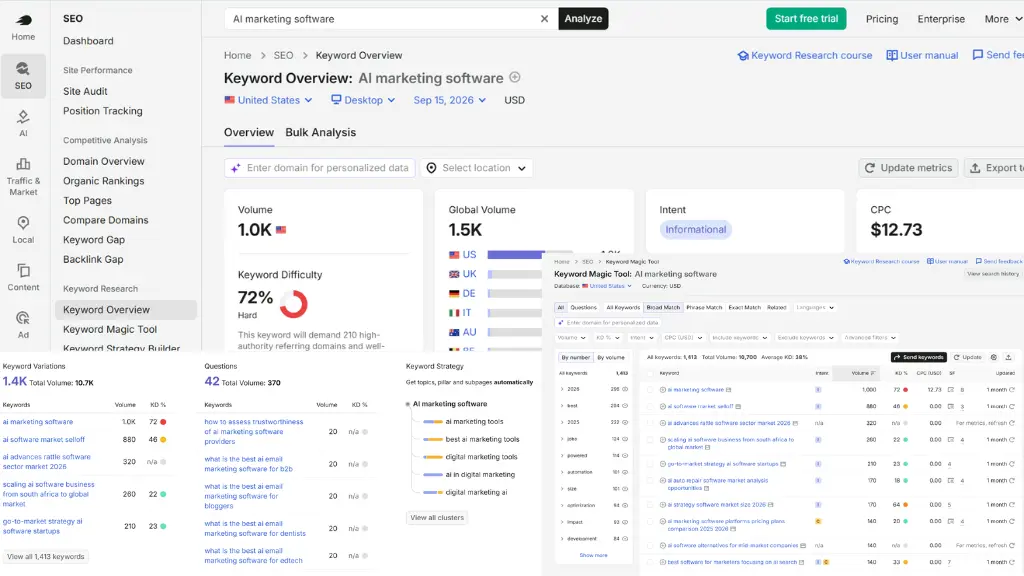
Semrush is one of the most comprehensive platforms here for keyword research, competitor analysis, site audits, rank tracking, content optimization, and increasingly AI-search visibility.
Key features: keyword research, competitor analysis, site audits, rank tracking, content optimization, AI search visibility, ad research.
Pricing: the SEO plan starts at $117.33/month billed annually (versus $139/month monthly).
Our verdict: powerful, but more than many small businesses need at first. It earns its cost once SEO is a major acquisition channel.
8. Surfer – best for SEO content optimization
Best for: optimizing SEO content.
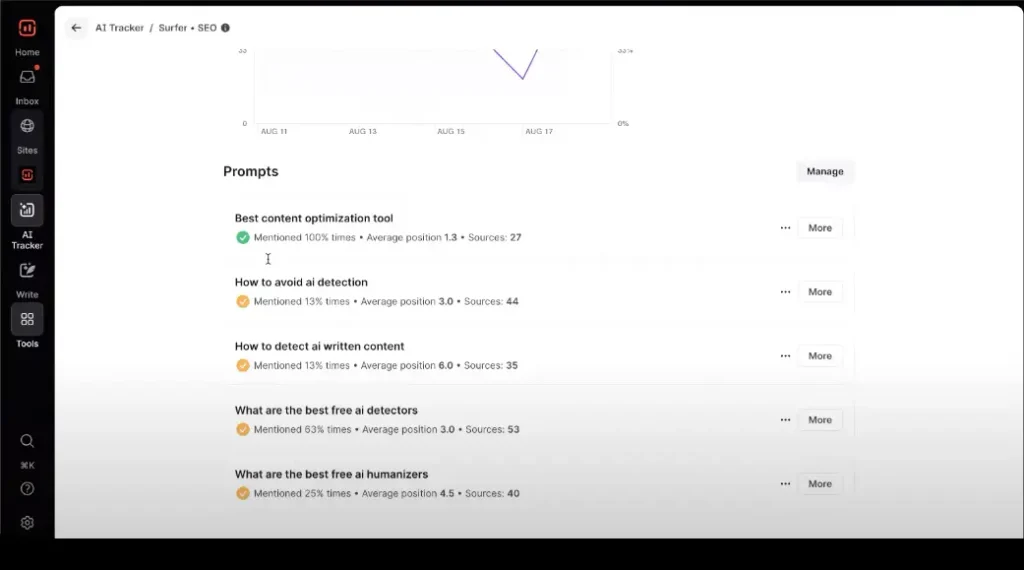
Surfer focuses on creating and optimizing content around search intent, and now includes AI-visibility tracking for ChatGPT, Google AI Overviews, Gemini, and Perplexity.
Key features: AI content optimization, content score, AI writing help, content audits, internal linking, AI visibility tracking, cannibalization reports.
Pricing: the Discovery plan starts at about €49/month (annual); Standard at €99/month.
Our verdict: especially useful if you publish SEO content regularly and want a structured way to improve existing pages.
9. AdCreative.ai – best for ad creatives
Best for: paid advertising creatives.
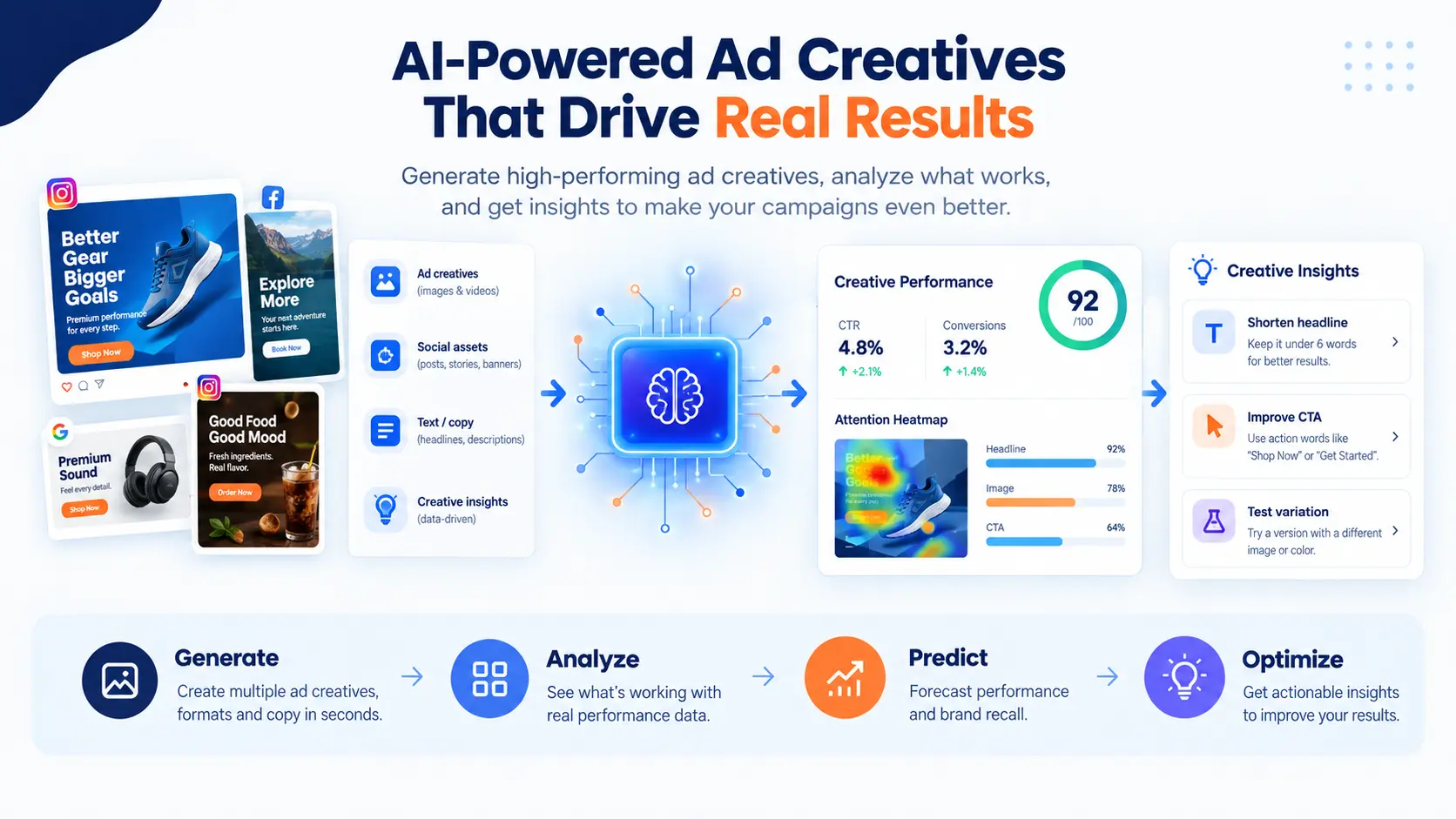
AdCreative.ai generates advertising assets and predicts which creative concepts are likely to perform ad creatives, social assets, text, and creative insights.
Key features: AI ad generation, ad copy, social creatives, creative scoring, multi-brand management, and advertising insights.
Pricing: Starter begins around $39/month (monthly billing), with lower effective rates on longer commitments.
Our verdict: worth it if paid ads are already a real part of your strategy and you need to test many creative variations quickly.
10. HubSpot – best all-in-one AI marketing platform
Best for: marketing automation and CRM.
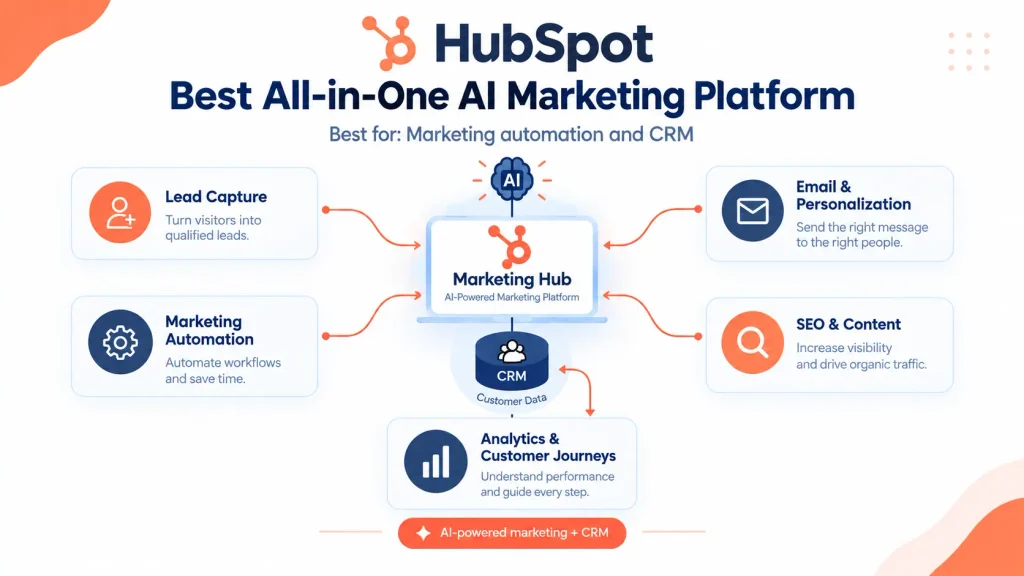
HubSpot‘s Marketing Hub combines lead capture, email, automation, personalization, SEO, customer journeys, analytics, and AI features in one place.
Key features: email marketing, automation, CRM, lead capture, SEO, personalization, AI agents, A/B testing, and revenue tracking.
Pricing: free plan available. Starter is about $10/month per seat (≈$9 annual), Professional starts at $890/month, and Enterprise at $3,600/month (Professional and Enterprise also carry onboarding fees).
Our verdict: excellent for connecting marketing, CRM, automation, and customer data but Professional and Enterprise get expensive fast for a very small business. If a CRM is your main need, compare options in our best all-in-one CRM guide.
AI marketing tools comparison
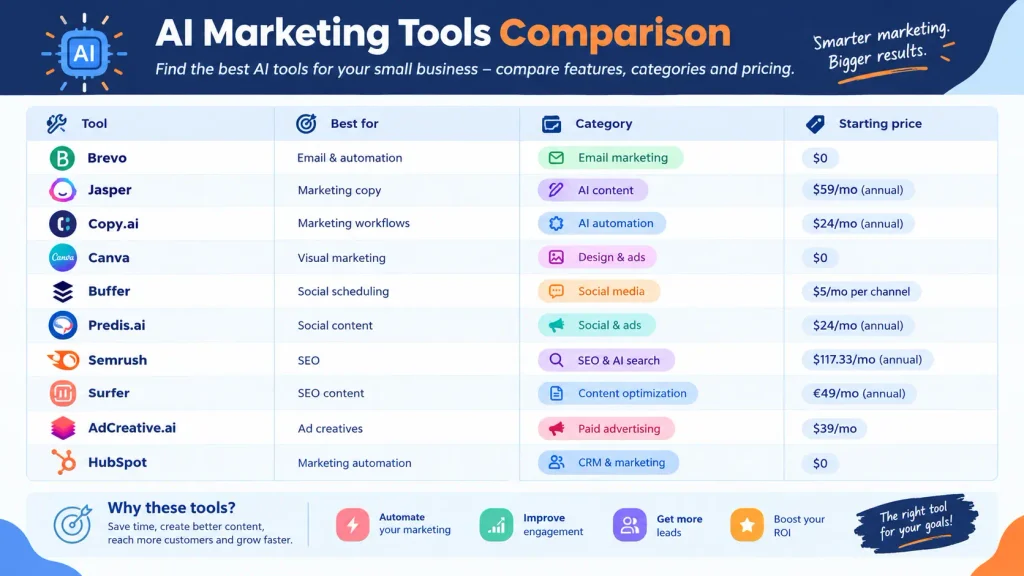
| Tool | Best for | Category | Starting price |
|---|---|---|---|
| Brevo | Email & automation | Email marketing | $0 |
| Jasper | Marketing copy | AI content | $59/mo (annual) |
| Copy.ai | Marketing workflows | AI automation | $24/mo (annual) |
| Canva | Visual marketing | Design & ads | $0 |
| Buffer | Social scheduling | Social media | $5/mo per channel |
| Predis.ai | Social content | Social & ads | $24/mo (annual) |
| Semrush | SEO | SEO & AI search | $117.33/mo (annual) |
| Surfer | SEO content | Content optimization | €49/mo (annual) |
| AdCreative.ai | Ad creatives | Paid advertising | $39/mo |
| HubSpot | Marketing automation | CRM & marketing | $0 |
Prices are current starting prices and can vary by billing cycle, usage, contacts, channels, or promotions.
How to choose the best AI marketing tools for a small business
Before paying for another platform, ask five questions:
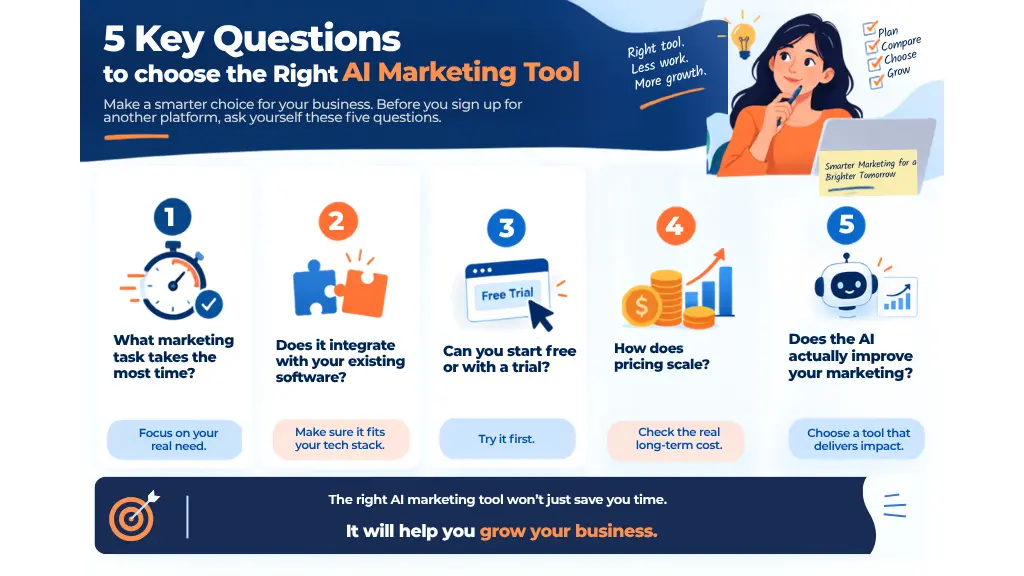
- What marketing task takes the most time? Start with your biggest bottleneck, not an all-in-one platform.
- Does it integrate with your existing software? A powerful tool is less useful if it creates another isolated workflow.
- Can you start free or with a trial? Test the workflow before committing.
- How does pricing scale? Look past the starting price costs rise with contacts, users, channels, credits, or AI usage.
- Does the AI actually improve your marketing? Faster content isn’t enough; it should save time, improve targeting, or lift results.
Final verdict
The best AI marketing tools for small business aren’t the ones with the most AI features they’re the ones that solve a specific marketing problem without adding complexity. For email, Brevo is a strong start. For visuals, Canva is hard to beat. Buffer and Predis.ai cover social; Semrush and Surfer suit SEO-focused businesses. For automation tied to customer data, HubSpot is the most complete. For heavy content or paid ads, Jasper and AdCreative.ai help you scale.
Build your stack gradually: start with one or two tools that solve your biggest bottlenecks, measure the results, and expand only when the software clearly saves time or improves performance.
FAQ

Fedora writes step-by-step guides for non-technical founders, turning complex SaaS setups into clear, follow-along tutorials. She focuses on getting small business owners from sign-up to first results without the jargon.