
AWeber has been sending marketing emails since 1998, longer than most of its competitors have existed. But “old” cuts both ways: it can mean battle-tested and reliable or dated and overpriced. So this AWeber review answers the only question that matters for a small business owner in 2026: Is it still worth your money, or have newer tools left it behind?
We’ll cover real USD pricing (including the big 2024 price hike everyone glosses over), the features that actually matter, the honest downsides, and exactly who should use AWeber and who should skip it.
This AWeber review is based on extensive research, pricing analysis, and real-world feedback from small business users. Throughout this AWeber review, we’ll focus on the features that truly matter in 2026.
AWeber at a glance
If you’re looking for an honest AWeber review without marketing hype, this guide explains both the strengths and weaknesses of the platform.
AWeber’s pricing is fair but not the most competitive on the market, and that one line sums up the whole platform. It’s a dependable, beginner-friendly email tool with rare 24/7 phone support, but it’s no longer the cheapest or most powerful option on the market.
- Rating: ⭐ 4.2 / 5
- Best for: Beginners, bloggers, and small service businesses who want reliable email and real human support
- Starting price: Free for up to 500 subscribers; paid from ~$12.50/month (annual)
- Free trial: Yes, a free plan plus a 14-day trial on paid plans
- Verdict in one line: A safe, simple choice for newcomers who value support over advanced automation.
<a href=”[AWEBER_AFFILIATE_LINK]” rel=”nofollow sponsored” target=”_blank”>Try AWeber free →</a>
What is AWeber? AWeber review
AWeber is one of the original email marketing platforms, founded in 1998 and based in Pennsylvania. It helps you collect email subscribers, send newsletters and automated sequences, and build simple landing pages all from one dashboard.
If you’re new to this category and want to understand where tools like this fit, our guide to what SaaS software is is a good primer. In short: AWeber is the “email engine” a small business uses to stay in touch with customers and turn subscribers into sales.
Its reputation rests on three things: strong email deliverability (your emails actually reach the inbox), genuinely helpful 24/7 support, and a low learning curve. It’s built for people who want to send good emails without becoming marketing engineers.
AWeber review: Key Features
Email builder and templates
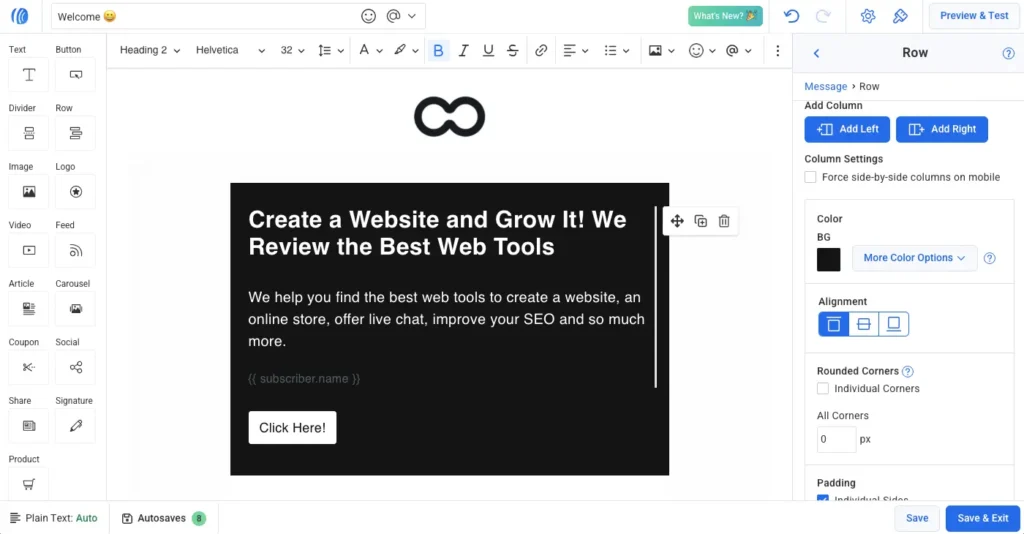
A drag-and-drop editor plus a “Smart Designer” that pulls colors and logos from your website to auto-build branded templates. It’s not the flashiest editor in 2026, but it’s fast and beginner-proof.
Automation and autoresponders
One reason this AWeber review remains positive is that automation is simple enough for beginners, even if advanced marketers may want more flexibility.
You can build welcome sequences and basic automated campaigns easily. On higher tiers, you get behavioral automation sending emails based on what a subscriber clicks or opens. This is solid for newsletters and simple funnels, though not as deep as automation-first tools like ActiveCampaign.
Landing pages and sign-up forms
Unlimited sign-up forms and a landing page builder let you grow your list even without a website. Note that the entry-level Lite plan caps you at 3 landing pages.
AI writing assistant
A built-in AI helper drafts subject lines and email copy. Useful for beating writer’s block, in line with what most 2026 email tools now offer.
24/7 human support
This is AWeber’s quiet superpower. Round-the-clock phone, email, and live chat support are rare in email marketing; most competitors make you wait or charge extra. For a non-technical owner in, say, Tulsa or Tampa, being able to call a human at 9 p.m. is worth real money.
AWeber review: Pricing in 2026
Here’s the honest breakdown. Two things to know upfront: AWeber raised prices significantly (roughly 50–150%) in December 2024, and every paid plan scales by subscriber count; the entry price is for a small list and rises as you grow.
| Plan | Price (USD) | Best for | Key limits |
|---|---|---|---|
| Free | $0 | Testing / tiny lists | Up to 500 subscribers, ~3,000 emails/mo, AWeber branding |
| Lite | from ~$12.50/mo (annual) | Beginners, newsletters | 3 landing pages, 3 automations, keeps branding, 1% e-commerce fee |
| Plus | from ~$20/mo (annual) | Growing businesses | Unlimited lists/automations/pages, A/B testing, branding removed, 0.6% e-commerce fee |
| Done For You | $79 one-time (promo, normally ~$599) | Non-technical owners | Experts build your whole system in 7 days |
Prices verified against AWeber’s 2026 pricing. Monthly billing costs more; annual billing saves roughly 17% on Lite and 33% on Plus. All paid plans scale up with your subscriber count.
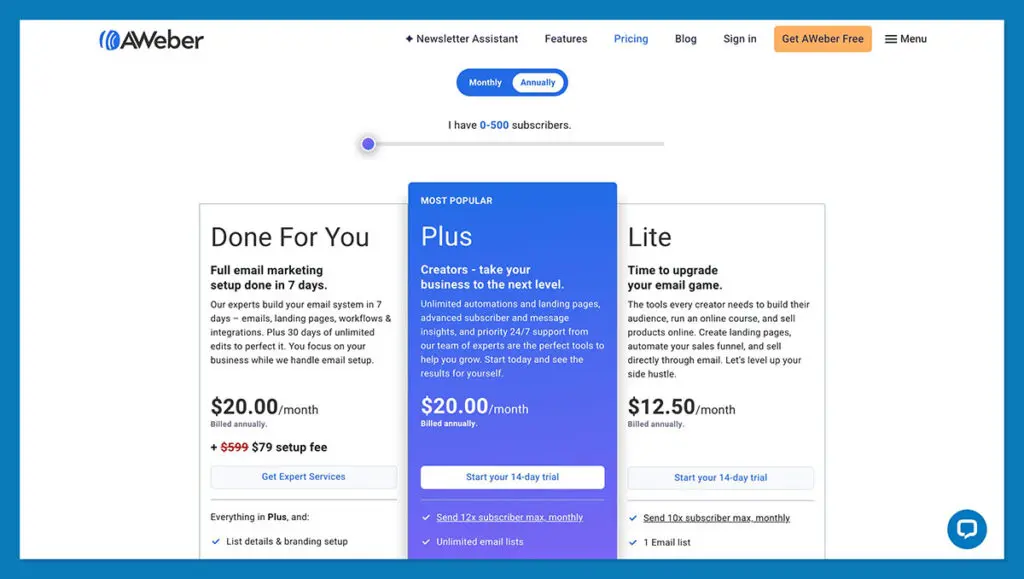
Overall, this AWeber review found that the Plus plan offers the best value for most small businesses with growing email lists.
The trap to avoid: people anchor on the ~$12.50 entry price and forget to model the cost at the list size they’ll actually have. At 5,000 subscribers, the Plus plan billed annually lands around $50/month, which is competitive but not the bargain the headline suggests. Always price it at your real list size.
<a href=”[AWEBER_AFFILIATE_LINK]” rel=”nofollow sponsored” target=”_blank”>See AWeber’s current plans →</a>
AWeber review: Pros and Cons
Pros
- Excellent, genuinely 24/7 support phone, chat, and email
- Strong deliverability and a 25+ year track record
- Beginner-friendly; fast to set up with Smart Designer
- A real free plan for up to 500 subscribers
- Big annual discount on the Plus plan (33%)
Cons
- Prices rose sharply in late 2024, and grandfathered plans were removed
- Costs scale by subscriber count model your real list size before committing
- Automation is basic compared to ActiveCampaign or GoHighLevel
- The Lite plan keeps AWeber branding and caps landing pages and automations
- Small e-commerce transaction fees (1% on Lite, 0.6% on Plus)
Naming the downsides isn’t a knock it’s the point. An email tool that fits a blogger is the wrong tool for a high-volume e-commerce store, and honest limits help you choose correctly.
An honest AWeber review should always highlight both advantages and limitations before recommending the software.
Who should use AWeber? AWeber review (and who should skip it)
AWeber is a great fit if you:
- Are new to email marketing and want a gentle learning curve
- Value being able to call real support at any hour
- Run a blog, newsletter, coaching, or local service business
- Have a small-to-medium list and mostly send newsletters and simple sequences
You should probably skip AWeber if you:
- Need deep, multi-branch automation as your growth engine
- Run a large e-commerce store with heavy segmentation needs
- Are on the tightest possible budget (cheaper tools exist with free plans)
AWeber Review vs Alternatives
Compared with newer competitors, this AWeber review shows that customer support remains one of AWeber’s biggest advantages.
AWeber sits in the “reliable middle” of the email market. If automation depth is your priority, ActiveCampaign goes further. If you want the cheapest entry with a free plan, MailerLite and Brevo compete hard. And if email is just one piece of a bigger puzzle, you also want a CRM, sales pipeline, and support tools. An all-in-one platform may serve you better than a standalone email tool.
| Tool | Free Plan | Best For | Starting Price |
|---|---|---|---|
| AWeber | ✅ | Beginners | $12.50 |
| MailerLite | ✅ | Budget users | $10 |
| Brevo | ✅ | Transactional email | $9 |
| ActiveCampaign | Trial | Automation | $15 |
| EngageBay | ✅ | CRM + Email | $13 |
Compared with MailerLite, Brevo, ActiveCampaign, and EngageBay, AWeber offers one of the easiest learning curves and the best customer support for beginners.
That’s worth thinking through before you commit: our comparison of the best all-in-one CRM for small business shows when a combined platform beats a dedicated email tool. And if you want a budget all-in-one that bundles email with a CRM, see our EngageBay review.
How to get started: AWeber review
Getting started takes about 15 minutes:
- Create a free account, no credit card needed for the free plan.
- Import or add your first subscribers (start with the free 500-subscriber tier to test).
- Use Smart Designer to auto-build a branded template from your website.
- Set up a simple welcome automation so new subscribers get a first email automatically.
- Add a sign-up form or landing page to start growing your list.
If it clicks, upgrade to Plus on annual billing for the best value.
<a href=”[AWEBER_AFFILIATE_LINK]” rel=”nofollow sponsored” target=”_blank”>Start your free AWeber account →</a>
After testing the platform and comparing competitors, this AWeber review confirms that AWeber is still a reliable choice for beginners in 2026.
AWeber review: Final verdict
Yes, for the right person. AWeber won’t win on price or automation power, but it wins where it counts for beginners: reliability, deliverability, and support you can actually reach. If you’re just starting email marketing and want a dependable tool that won’t overwhelm you, AWeber is a safe, sensible choice. Start on the free plan and upgrade to Plus (annual) once your list grows.
If your business lives and dies by advanced automation, or you want everything under one roof, look at an all-in-one platform instead. But for straightforward, well-supported email marketing, this 25-year veteran still earns its place.
Overall, this AWeber review recommends starting with the free plan before upgrading once your subscriber list begins to grow.
Frequently asked questions
If you’re still comparing email marketing software, don’t miss our guide to the Best SaaS Tools with Free Trial in 2026, where we compare more beginner-friendly business tools.

Fedora writes step-by-step guides for non-technical founders, turning complex SaaS setups into clear, follow-along tutorials. She focuses on getting small business owners from sign-up to first results without the jargon.